What “Natural” Actually Means on an Incense Label
“Natural incense” is one of the fastest-growing searches in this category. Over the past twelve months it has risen several times over in US search interest. That growth is real.
The problem is that the word itself carries almost no legal weight on an incense label. So here is what we can actually tell you — and what we cannot.
What we list, and why
Every stick we sell is made to a formula we can name and cite. We work from formulas recorded in Xiang Cheng (香乘), a Ming-dynasty incense manual compiled by Zhou Jiazhou, whose complete text is publicly readable and verifiable. When we say a material is in a formula, you can look it up.
That is the whole basis of the claim we make: we publish the formula, and you can check it. Not “ancient wisdom.” Not “pure.” A citation.
What “natural” does not guarantee
This matters more than the marketing language suggests.
- Natural does not mean safe. Aconite (乌头) and langdu (狼毒) are plants. They are also toxic, and they appear in historical incense and medicinal texts. We do not use them.
- Natural does not mean no additives. Traditional incense is bound with something — honey, fruit juice, gum. A stick with no binder is a pile of powder.
- “Natural” is not a certified term for this product category in the US. There is no incense-specific natural certification. Anyone claiming one is inventing it.
The negatives we can verify
A negative claim is easier to check than a positive one, so we lead with those. Our formulas do not contain:
- Realgar (雄黄) — an arsenic-bearing mineral used in some historical formulas. Excluded.
- Aconite (乌头) and langdu (狼毒) — toxic plants. Excluded.
- Musk — a CITES-regulated animal product; many classical formulas call for it, so we use non-musk versions.
These are checkable statements, not assurances. If our formula list says a material is absent, and you find it in the batch, that is a defect you can hold us to.
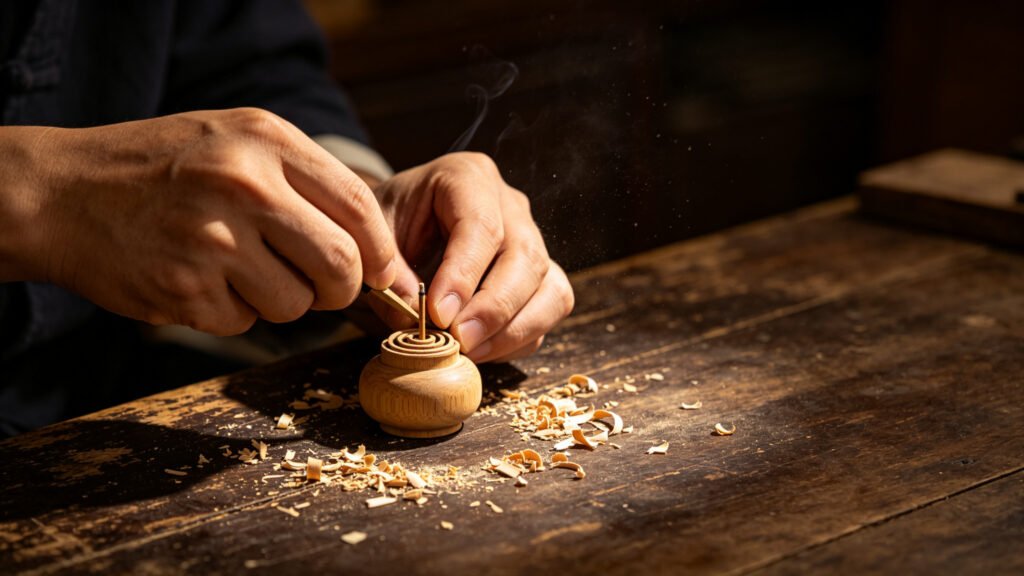
How the sticks are actually made
We counted the craft steps across 1,261 formula entries in the Ming text we work from. The common ones, by frequency:
| Step | Entries | Share |
|---|---|---|
| Bound with honey | 206 | 16.3% |
| Pressed into cakes or pellets | 169 | 13.4% |
| Stored to mature (窨) | 98 | 7.8% |
| Bound with pear juice | 29 | 2.3% |
Honey binding, pressing, and maturing are the ordinary method. Pear juice is a specific technique used in a minority of formulas — including the well-known bed-curtain incense attributed to Li Yu of the Southern Tang. It is worth naming, but it is not the norm, and we will not pretend it is.
A note on smoke
“Low smoke” is frequently claimed and rarely defined. We are not making a smoke measurement claim yet, because we have not measured it under a stated method. When we do, we will publish the method alongside the number.
If you keep pets
Any burning produces fine particulate matter, and veterinary research has examined indoor air pollution in households with cats and dogs. If you share a small, poorly ventilated space with a pet, ventilate, burn less, and ask your vet. We do not sell “pet-safe” incense, because no such certification exists.
Where to go next
Is incense bad for cats? What the published research actually shows
2 thoughts on “What “Natural” Actually Means on an Incense Label”